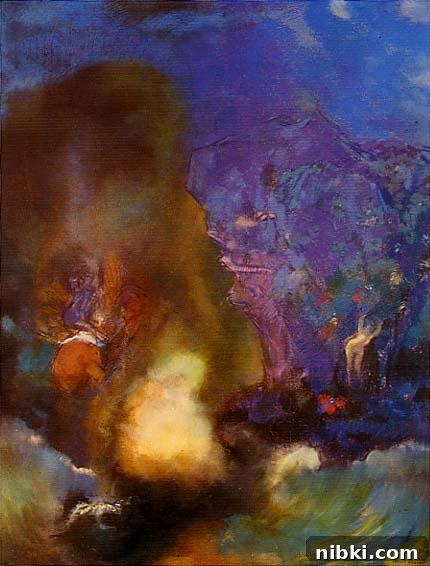
This painting evokes a sense of wonder and childhood imagination. Odilon Redon, the artist, often drew on dreamlike imagery and poetic sources to create works that blur the line between reality and fantasy. Roger and Angelica, painted in 1910, is one such work: a richly colored scene inspired by the Renaissance epic Orlando Furioso, in which the knight Roger rushes to rescue the maiden Angelica from a fearsome dragon. The composition and palette combine to produce a mood that feels both intimate and mythic.
When I look at this painting I am reminded of the vivid way children invent stories around the skies and landscapes they see. Like many viewers, I find the piece suggestive of evenings spent watching shifting clouds and imagining other worlds. Redon has long been associated with a visual language that privileges suggestion over explicit detail, and in this canvas he uses color and form to convey emotion more than literal narrative. The figures—Roger, Angelica, and the dragon—are present, but they inhabit an atmosphere that feels charged with feeling rather than strict realism.
Color takes center stage in Roger and Angelica. Rather than relying on precise lines or academic representation, Redon builds the scene through harmonious and sometimes unexpected hues. These colors create depth and movement, and they guide the viewer’s eye from the peril of the dragon to the urgency of the rescue and to the fragile figure of Angelica. The result is an image that reads as an emotional snapshot: a moment of danger, bravery, and tenderness rendered through paint.
Redon’s interest in literary and mythic themes is clear here. Orlando Furioso, the long epic that inspired the subject, contains episodes of chivalry, enchantment, and transformation—qualities that resonate with Redon’s sensibility. In choosing this episode, the artist links personal fantasy with a broader cultural imagination, inviting viewers to respond with their own memories and associations. The painting becomes a catalyst for storytelling, encouraging us to fill in the scene before and after this decisive instant.
Although the work shows the traces of a narrative source, its power depends on the way the scene is felt rather than read. The dragon’s presence introduces danger, but it is the relationship between Roger and Angelica—the urgency, the protection, the emotional intensity—that dominates the composition. Redon’s technique supports this focus: loose edges, layered pigments, and a painterly handling that makes light and shadow serve psychological expression. In this way the painting reflects a Romantic sensibility while also pointing toward the Symbolist interests that informed much of Redon’s career.
Today Roger and Angelica is part of the collection at the Museum of Modern Art in New York City, where it can be studied alongside other works by Redon and his contemporaries. Seeing the painting in person—or viewing a high-resolution image through museum imaging projects—allows one to appreciate the subtle shifts in color and texture that give the scene its dreamlike quality. For anyone interested in the intersections of literature, myth, and visual art, this work provides a rich example of how a single image can encapsulate narrative momentum and emotional depth.
If you wish to explore further, resources such as museum catalogs and online art archives often include detailed images and curatorial notes for Roger and Angelica. References to the Google Art Project or archives of art essays and blogs can help contextualize Redon’s approach and the painting’s place within early 20th-century art. The painting continues to inspire viewers—whether they come with scholarly intent or simply with the kind of imaginative curiosity that first drew many of us to art as children.
Daily Dose of Beauty Archives