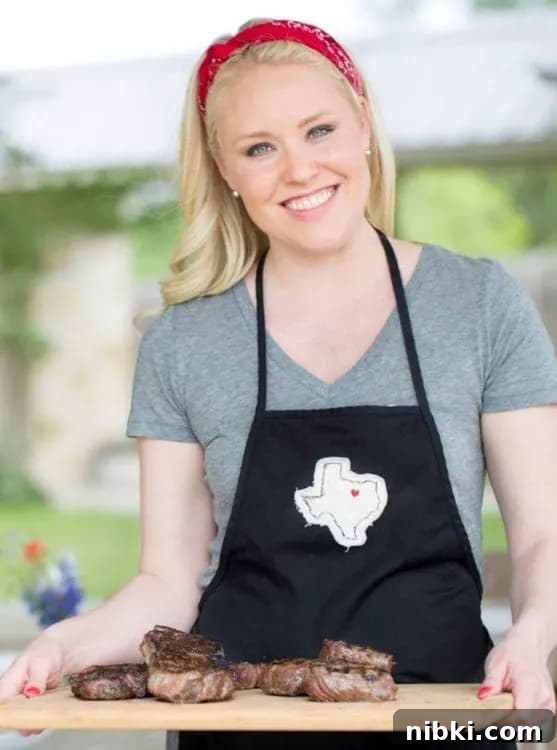
In Episode 034, Taryn interviews Sarah Penrod of Urban Cowgirl about smoking brisket. Brisket can feel intimidating, but Sarah breaks the process into clear, manageable steps anyone can follow. She has an entire Brisket School section on her site to help home cooks build confidence. In the episode Sarah shares practical tips for selecting, trimming, seasoning, smoking, and resting brisket, plus ideas for using leftovers. Listen and learn from a Texas expert.
Listen on iTunes, Stitcher, TuneIn, or your favorite podcast player. Or scroll down to read a full transcript.
GUEST DETAILS
Connect with Sarah.
Website | Instagram | Facebook | YouTube | Pinterest
Bio: Sarah Penrod, the Urban Cowgirl, is a bestselling cookbook author, Food Network personality, and seventh-generation Texan. She has served as a Texas media ambassador for the White House’s Chefs Move to Schools program and cooked for high-profile clients. Sarah’s work focuses on Texas-style barbecue, especially smoked brisket.
RESOURCES MENTIONED
Some of the following are affiliate links. As an Amazon Associate, I earn from qualifying purchases.
- Masterbuilt smoker
- Traeger pellet grill
- Recteq grill
- Paper towels
- Large cutting board with grooves
- Sharp knife for slicing and trimming
- Wood chips for smoking
- Foil pan for water
- Heavy duty foil
- Pink butcher paper
- Recteq BBQ cooler
RECIPES MENTIONED
Recipes Sarah mentioned in the episode, mostly on Urban Cowgirl.
- Urban Cowgirl Brisket School
- Texas brisket rub
- Brisket spray recipe
- Blue ribbon potato salad
- Pineapple coleslaw (Hot Pan Kitchen)
- Smoked baked beans
- Sauteed green beans (Hot Pan Kitchen)
- Mashed potatoes (Hot Pan Kitchen)
- Poblano mac n cheese
- Texas twinkies
- Texas brisket queso
TRANSCRIPT
Taryn Solie: Hello, grillers. I hope you had a great Labor Day weekend. For many, Labor Day is the last hurrah of summer and a time for big barbecues, but grilling season doesn’t have to end. Today I talk with Sarah Penrod, Urban Cowgirl, about smoking brisket. Brisket feels complicated to many home cooks, and Sarah makes it approachable.
Sarah Penrod: Thanks for having me.
Taryn Solie: Tell us about your background—how you became a chef and how brisket became your focus.
Sarah Penrod: I grew up near Dallas in a family of restauranteurs and later attended culinary school in Arizona. I worked as a private chef and landed early opportunities cooking for notable clients. I also helped with the Chefs Move to Schools program in Texas. Over time my interest in barbecue grew, especially brisket, and I now document techniques and recipes on Urban Cowgirl, including a dedicated Brisket School.
Taryn Solie: Brisket can be intimidating. Can you give a concise overview for someone who wants to try it?
Sarah Penrod: Brisket is the pectoral muscle of the steer and comes in two parts: the flat and the point. Smoking brisket is different from braising because you aren’t adding liquid—you’re slowly converting connective tissue into gelatin inside the meat, using its own fat to stay moist. That transformation is what makes smoked brisket so special, but it does require patience and the right approach.
Taryn Solie: What should someone look for when buying a brisket?
Sarah Penrod: I recommend buying a whole brisket (both flat and point) even the first time. They range from about eight to 20 pounds. Choose whatever grade you can find—choice, select, prime, or Wagyu if available. Don’t stress over tiny differences at first; you’ll improve with each cook.
Taryn Solie: How about trimming and prepping?
Sarah Penrod: Trimming isn’t mandatory—many great briskets are minimally trimmed—but if you choose to trim, firm the brisket by putting it in the freezer for 30 minutes so the fat cuts cleanly. Trim the fat cap to about a quarter-inch if desired. Use a large cutting board and a very sharp knife. Save or render trimmed fat if you’d like; there are many uses for it.
Taryn Solie: What rubs and seasonings do you recommend?
Sarah Penrod: In Texas we tend to keep beef simple so the meat remains the star. A classic Texas rub is kosher salt and black pepper—often called a Dalmatian rub. I add a bit of garlic and onion powder to enrich the flavor. Southern pitmasters sometimes use brown sugar and paprika; that’s a valid style too. Don’t over-salt or “over-rub”—bark forms through a chemical reaction and the meat needs to breathe, so you should still see some meat beneath the rub after seasoning.
Taryn Solie: What about wood and smoke?
Sarah Penrod: Use a robust wood for beef—oak or post oak is classic. Pellet manufacturers sell beef blends that work well. Fruit woods can be too subtle for brisket. The key is producing consistent, steady smoke.
Taryn Solie: Any guidance on smoker setup and temperature?
Sarah Penrod: Always include a water pan to keep the smoker chamber humid; that helps bark formation and smoke penetration. Classic smoking temperatures are around 225°F, though some cooks use a “hot and fast” method near 250°F. Stay within that window rather than obsessing over exact numbers.
Taryn Solie: What is the “stall” and how do you handle it?
Sarah Penrod: The stall occurs around 160–170°F when evaporative cooling slows the internal temperature. To bypass the stall you can wrap the brisket in foil or pink butcher paper—foil traps heat and ends the stall quickly, while butcher paper allows some breathing and preserves more bark. Both methods work; try both and see which you prefer.
Taryn Solie: When should you pull the brisket and how do you rest it?
Sarah Penrod: A common target for doneness is about 203°F, though many cooks pull slightly earlier and let carryover and resting finish the job. Resting is crucial: keep the brisket wrapped in butcher paper or foil, then towel-wrap and place in a well-insulated cooler (no ice). Let it rest for one to four hours; this relaxes the meat and concentrates juices.
Taryn Solie: What sides and uses for leftovers do you recommend?
Sarah Penrod: Classic sides include potato salad, coleslaw, baked beans, mac and cheese, and mashed potatoes. Leftover brisket is excellent in sandwiches, quesos, enchiladas, or frozen for quick meals. Sarah also recommends creative appetizers like Texas Twinkies—jalapeños stuffed with cream cheese and brisket, wrapped in bacon, then smoked or grilled.
Sarah Penrod: The biggest takeaway is: don’t be intimidated. Cook brisket a few times, learn what you prefer, and ignore the noise. Brisket is forgiving once you understand the basics, and the leftovers make it a great make-ahead protein for many meals.
Taryn Solie: Thanks, Sarah. Where can listeners find your recipes and Brisket School?
Sarah Penrod: Visit Urban Cowgirl at urbancowgirllife.com. All recipes are free, and Brisket School and step-by-step videos are available on the site and YouTube. Reach out on social media at Urban Cowgirl—I’m happy to answer questions.
Outro: That’s it for today. Thank you for listening and until next time, keep grilling like a mother.