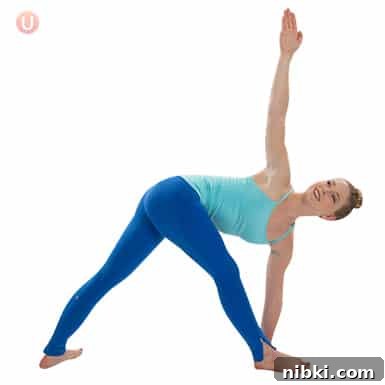
Revolved Triangle, also known in yoga as Parivrtta Trikonasana, is a standing twist that lengthens and strengthens simultaneously. It targets the legs, hips, groin, hamstrings, calves, shoulders, chest and the entire spine—with particular emphasis on the lower back and the muscles that support upright posture. Practiced with care, Revolved Triangle is an efficient way to improve spinal mobility, unwind tight hips, and increase balance and body awareness.
This pose builds directly on the fundamentals of the basic Triangle Pose. If you are still refining alignment in Triangle, take time to master that foundation first; the rotation in Revolved Triangle is most effective and safe when the basic posture and straight-leg engagement are established. If you want a primer before attempting the twist, see our guide to the basic Triangle Pose.
Revolved Triangle opens the chest while compressing and lengthening opposite sides of the torso, creating a balanced, dynamic stretch. It helps counteract rounded shoulders and a hunched upper back that commonly develop from long hours at a desk. Because it combines a standing base with a rotational element, it also improves balance and coordination.
If your hamstrings or hips are tight, the twist can feel intense. Use props as needed: a sturdy yoga block placed in a tall or medium height under your supporting hand gives a reliable surface to maintain alignment without collapsing. You do not have to reach the floor; placing your hand on your shin or a block keeps the spine long and the twist effective.
Revolved Triangle Pose Instructions
- Begin standing. Step your left foot back along the mat so the feet form a wider stance; angle the back foot slightly and ground through both feet. Both legs should be active and straight, but avoid locking the knees.
- Square your hips as much as possible toward the front of the mat. Reach your right arm forward over the right leg and your left arm back over the left leg, keeping the torso long and the spine lifted.
- On an exhale, rotate your torso to the right. Bring your left hand down toward the right foot while your right hand reaches up toward the sky. The left hand can rest on the top of the right shin, ankle, a block, or the floor—choose the option that preserves length through the spine.
- Keep both legs engaged: active quadriceps and a rooted back heel help stabilize the pelvis so the rotation occurs through the thoracic spine rather than collapsing into the lower back.
- Breathe steadily, drawing each inhale to lengthen the spine and each exhale to soften into the rotation. Hold the pose for about 30 seconds to a minute, then rise with control and repeat on the opposite side.
Practical cues to help the twist: press evenly through both feet, lift the chest before you deepen the rotation, and imagine creating space between each vertebra as you twist. Avoid forcing the torso further than your current mobility allows—work gradually and respect any sharp discomfort.
Common adjustments and variations: use a block under the lower hand to maintain alignment; micro-bend the front knee if the hamstring is very tight; perform the pose with a shorter stance to reduce intensity. If you have pre-existing back or neck concerns, move slowly and consider guidance from a qualified instructor.
Revolved Triangle is an accessible yet challenging pose that offers significant benefits for posture, spinal mobility, and muscle release when practiced consistently. For additional practices that support back health and posture, consider exploring our post on 12 Yoga Poses To Help Alleviate Back Pain.
Listen to your body, progress step by step, and focus on alignment and breath rather than depth. With regular practice, Revolved Triangle becomes a reliable tool for increasing stability, opening the hips and chest, and restoring a taller, more comfortable posture.